
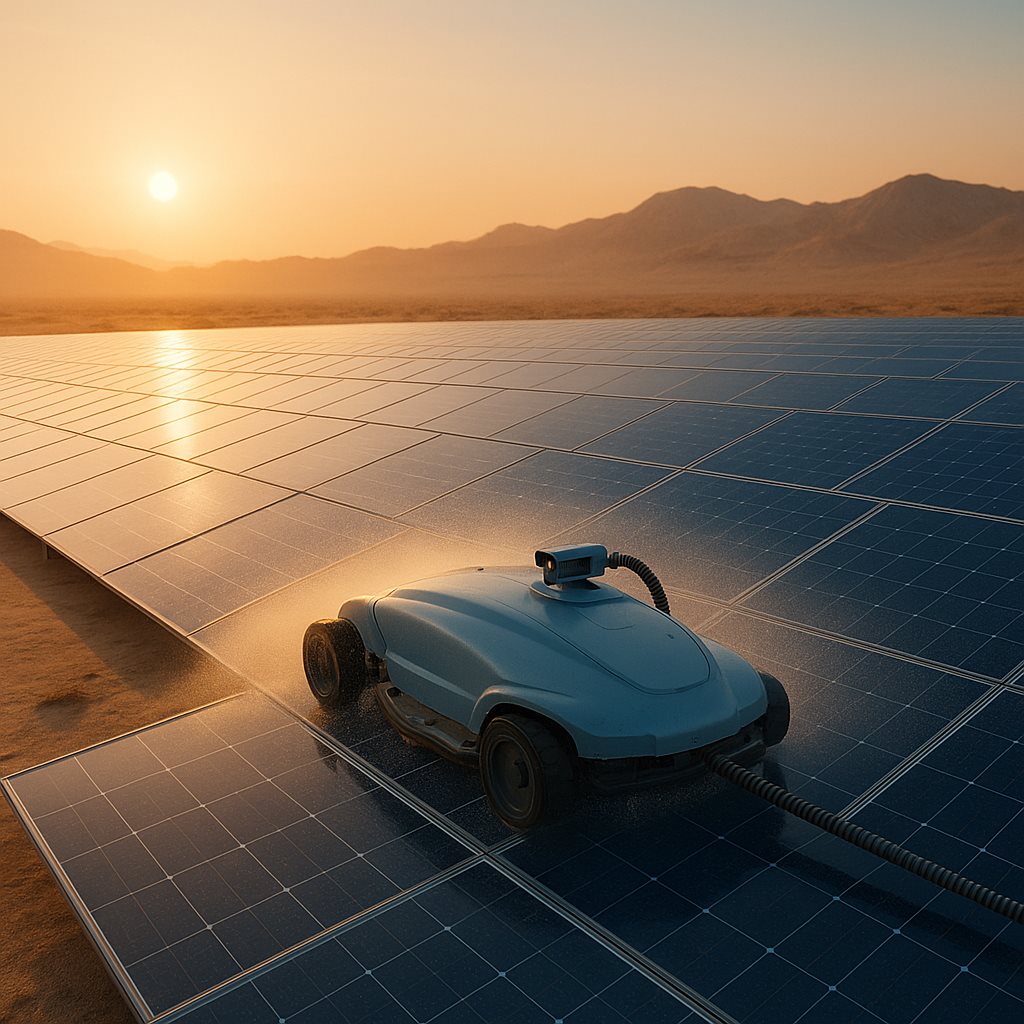
Picture a robot gliding across a desert solar array at dawn, scrubbing months of caked dust off the glass – with no power cable trailing behind it, no rail bolted to the modules, and no technician walking alongside. The only thing driving it is water. That is the idea behind a water-powered solar panel cleaning robot, and it is quietly changing how large PV sites stay clean and productive.
What Makes a Cleaning Robot “Water-Powered”?
Most robotic cleaners rely on electric motors and onboard batteries to move brushes and drive wheels. A water-powered robot flips that model: it uses the pressure and flow of the cleaning water itself to power its motion and its cleaning action. Instead of asking the site to supply grid electricity or swap batteries, the machine converts hydraulic energy – water under pressure – directly into mechanical work.
The result is a system that cleans and propels itself from a single resource. That simplicity removes several of the failure points that hold back conventional robots on large, remote installations, where power supply and battery logistics are a constant headache.
The Hydraulic Advantage: High Torque, Low Pressure
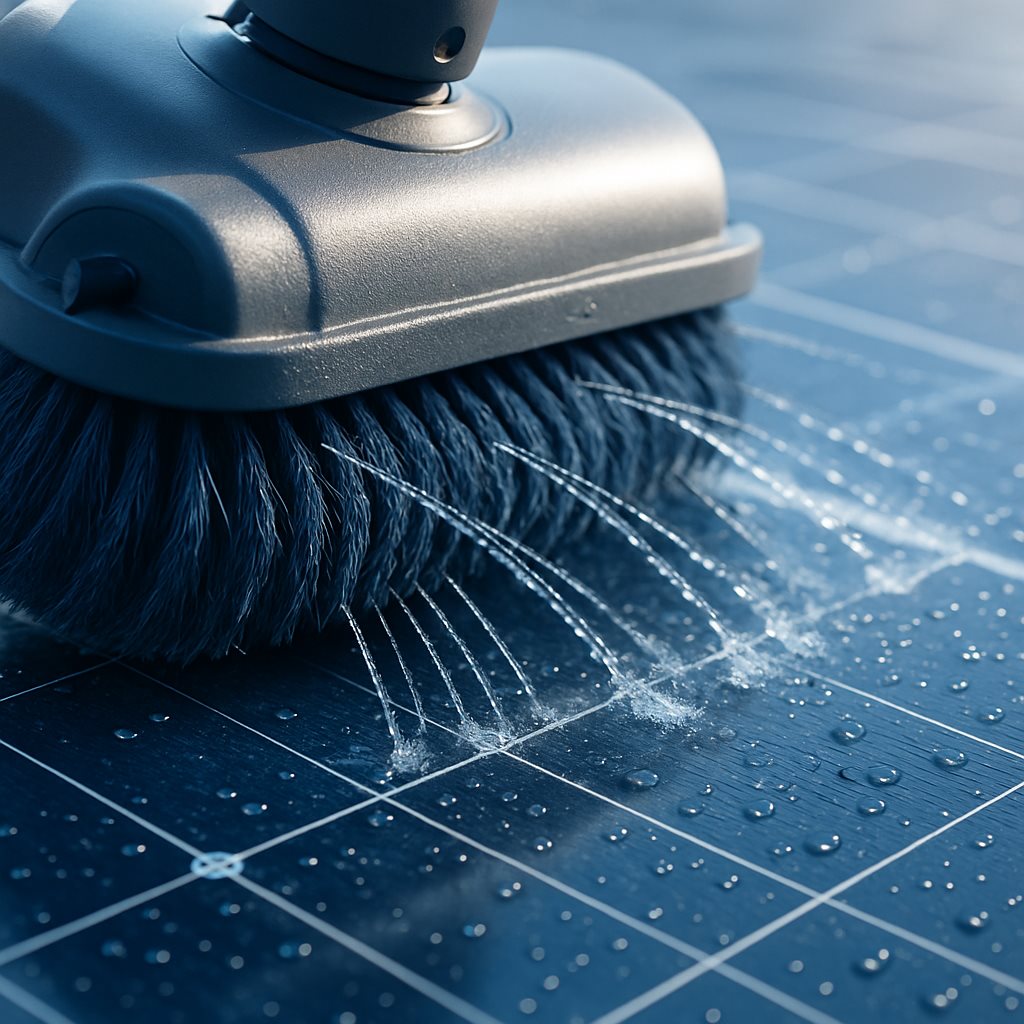
The heart of a hydraulic solar panel cleaning robot is its motor. Solaris Hydrobotics was built around a patented high-torque, low-pressure hydraulic engine – the invention that made this category practical. The “high-torque, low-pressure” part matters more than it sounds:
- High torque gives the robot the muscle to move brushes through stubborn, stuck-on grime, not just loose dust.
- Low pressure means the water works the mechanism gently, without the harsh blasting that can stress panel glass and coatings over time.
Because the motor runs on ordinary water pressure rather than high-voltage electronics, there is far less to overheat, short out, or fail in the field. You can see how this engine drives the full cleaning cycle on our how it works page.
No Electricity, No Rails, No Operator: Why It Matters
Water-powered design unlocks three practical advantages that map directly to lower cost and less risk:
- No grid electricity. The robot does not draw from the array or the local grid, so it adds no parasitic load and needs no electrical infrastructure to deploy.
- No rails. There is nothing permanent to bolt onto the modules or mounting structure. That means lower installation cost, no added shading, and freedom to redeploy the robot across different sections of a site.
- No operator. The system runs autonomously, so cleaning does not depend on scheduling a crew or sending people onto rooftops and elevated arrays.
Each of these removes a recurring cost or a safety exposure, which is a large part of why the ROI of autonomous cleaning is so strong for commercial and utility-scale operators.
Where Water-Powered Robots Excel
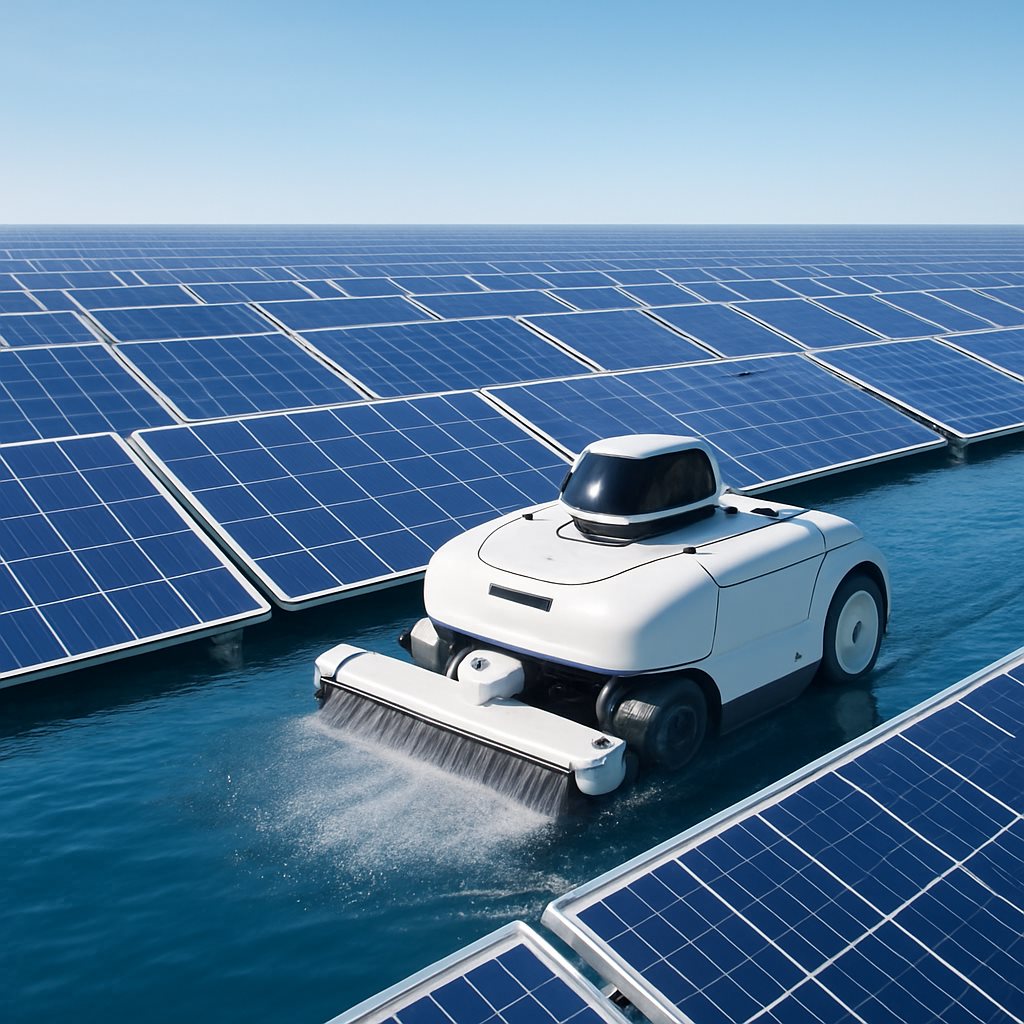
Because the design carries its own power source and needs no fixed track, it adapts to environments that give conventional systems trouble:
- Utility-scale ground arrays. The huge surface area of a utility-scale ground-mounted solar field is exactly where rail-free, autonomous cleaning pays off, since manual methods cannot keep pace affordably.
- Floating solar. On water, adding electrical cabling and rails is complex and risky. A water-powered approach is a natural fit for floating solar arrays.
- Arid and dusty regions. Sites with heavy soiling need frequent cleaning, and a self-powered robot can deliver that cadence without a growing labor bill.
How It Compares to Electric and Rail-Based Systems
Electric and rail-based robots can clean effectively, but they carry structural commitments: rails must be installed and maintained, batteries must be charged or swapped, and both add cost and points of failure across a large site. A water-powered, rail-free system trades that complexity for a single water supply and autonomous operation. For most large arrays, that is the difference between a cleaning program that scales and one that stalls.
The Bottom Line
A water-powered solar panel cleaning robot answers a very practical question: how do you keep a large PV site consistently clean without piling on electricity, infrastructure, and labor? By turning water pressure into both movement and cleaning force, and by using a high-torque, low-pressure hydraulic motor, it removes the constraints that limit conventional cleaners – while treating the glass gently enough to protect long-term yield. To see whether a water-powered system fits your site, request a demo and our team will walk you through the numbers for your installation.
Frequently Asked Questions
How does a water-powered solar cleaning robot move without electricity?
It converts the pressure and flow of the cleaning water into mechanical motion through a hydraulic motor. The same water that cleans the panels also drives the robot, so no grid power or onboard battery is required.
Is a hydraulic cleaning robot gentle enough for solar panels?
Yes. A low-pressure hydraulic design applies steady, controlled force rather than high-pressure blasting, which helps remove stuck-on grime while minimizing the micro-abrasions that can shorten panel life.
Does a water-powered robot need rails on the panels?
No. Rail-free operation is one of its main advantages – there is nothing permanent to install on the modules, which lowers cost, avoids added shading, and lets the same robot serve different parts of a site.
How much water does it use?
Water-based robotic cleaning is engineered to be efficient, using far less water than manual washing while still clearing heavy soiling. In arid regions this efficiency is a key part of keeping cleaning both effective and sustainable.
What types of solar installations is it best for?
It suits large and hard-to-service sites in particular – utility-scale ground arrays, floating solar, and dusty or arid installations – where self-powered, rail-free, autonomous cleaning is most valuable.