
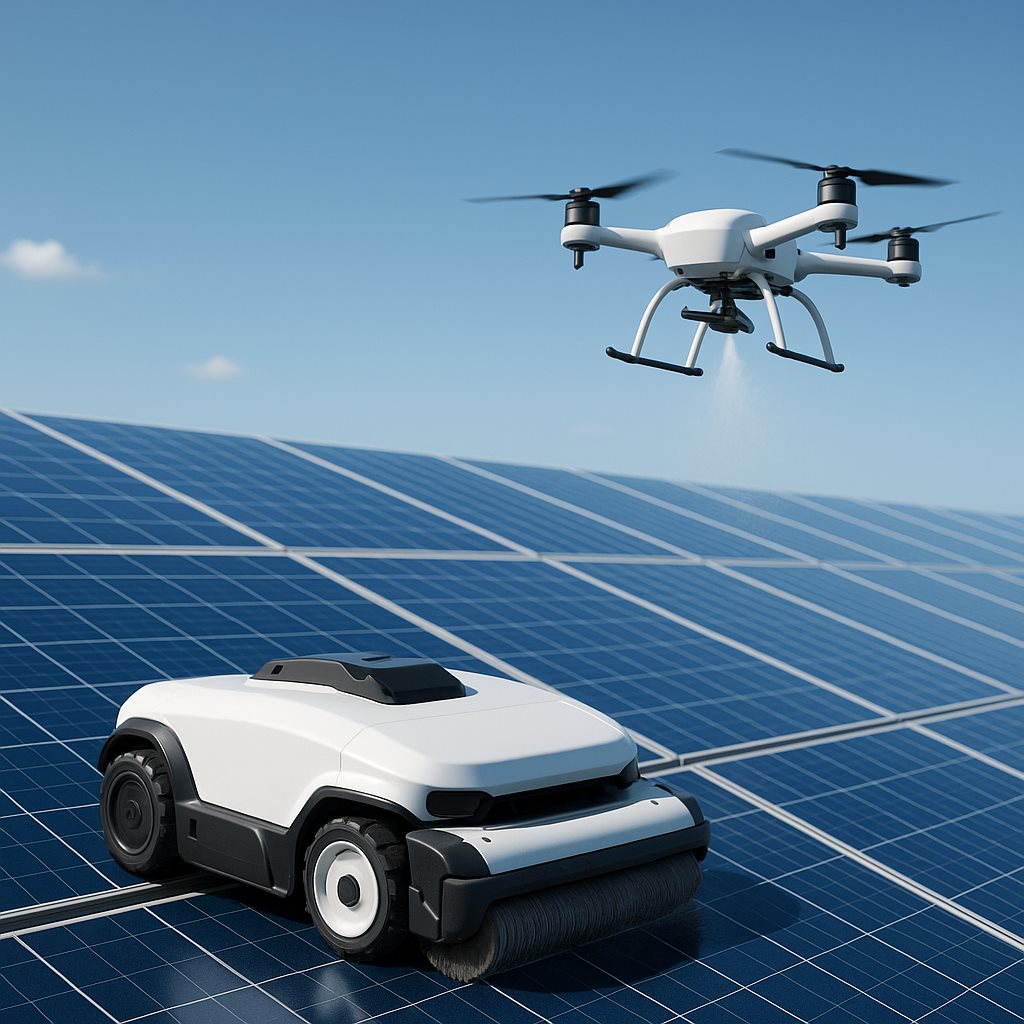
As solar operators look to automate cleaning, two very different machines get pitched: ground robots that crawl across the panels, and drones that clean from the air. Both promise to replace manual crews, but they solve the problem in fundamentally different ways – with real consequences for coverage, cleaning power, and cost. Here is an honest comparison of robots vs drones for solar panel cleaning.
The Rise of Automated Solar Cleaning
Manual cleaning is slow, costly, and hazardous, so the market has raced to automate it. Ground robots and cleaning drones are the two leading answers. Choosing between them is not about which is more futuristic – it is about which reliably keeps panels clean at the scale and cost your site demands.
How Drone Cleaning Works
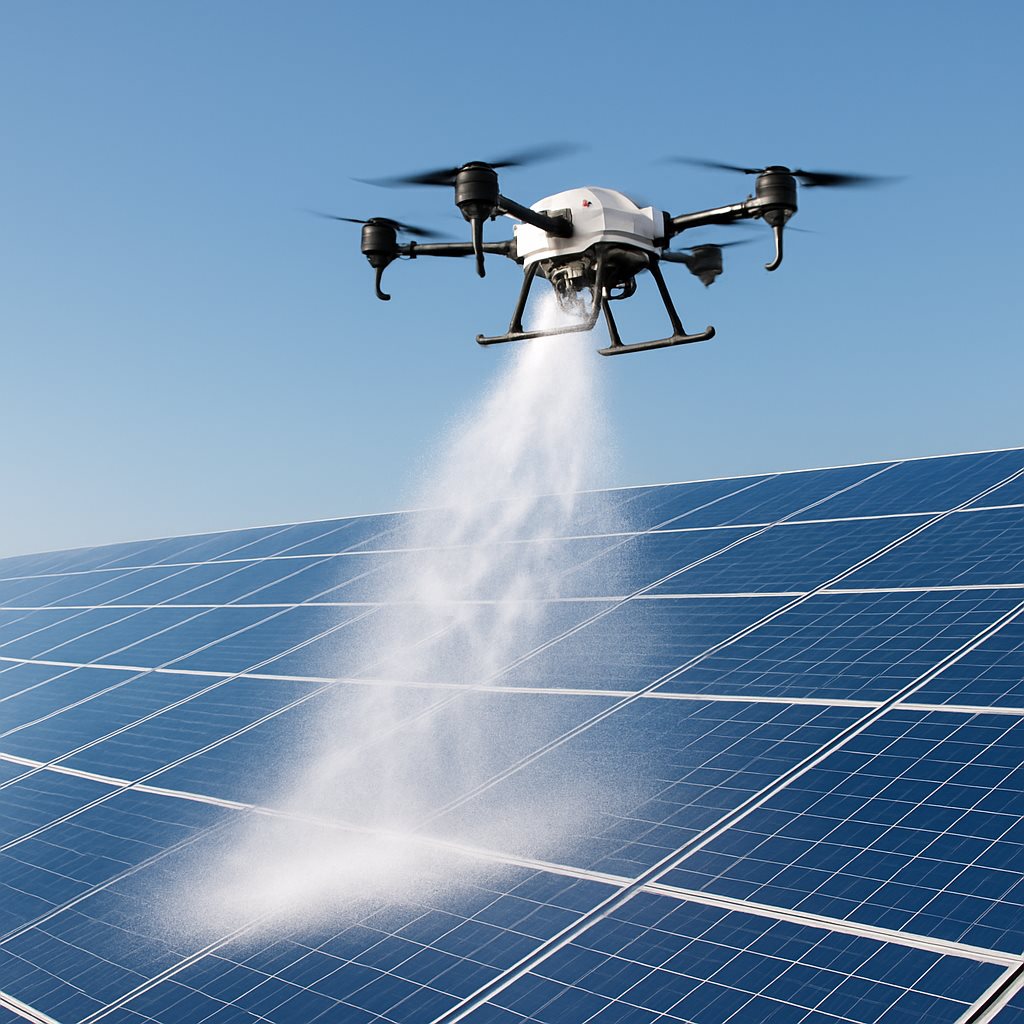
Cleaning drones fly over the array and spray water, sometimes with a light detergent, onto the panels from above. Their appeal is speed and access – they can reach spots that are awkward on foot, and they need no equipment installed on the array. But flying introduces hard limits:
- Short flight time. Battery life caps how long a drone can work before recharging or swapping.
- Weather sensitivity. Wind and heat interfere with stable flight and spraying.
- Limited scrubbing. Spraying from the air rinses loose dust but struggles with stuck-on grime that needs mechanical contact.
- Water use and drift. Spraying from above wastes water to overspray and evaporation.
How Ground Robots Work
A ground robot moves directly across the panel surface, combining water with brushing to lift dirt in contact with the glass. Because it touches the panels, it can remove bonded soiling that a spray cannot. Autonomous, rail-free designs need no fixed track, and water-powered models need no grid electricity or batteries at all – the mechanics are covered on our how it works page. The trade-off is that a robot works section by section rather than flying between them.
Coverage, Cleaning Power, and Cost
The two approaches diverge on what matters most:
- Cleaning power: robots win. Contact cleaning removes stuck-on grime and bird droppings; aerial spraying mostly handles light dust.
- Endurance: robots win. No flight-time ceiling means sustained cleaning across large arrays.
- Water efficiency: robots win. Cleaning in contact uses water where it counts, with less overspray.
- Awkward access: drones have an edge on scattered, hard-to-reach installations.
Which Wins for Large Sites?
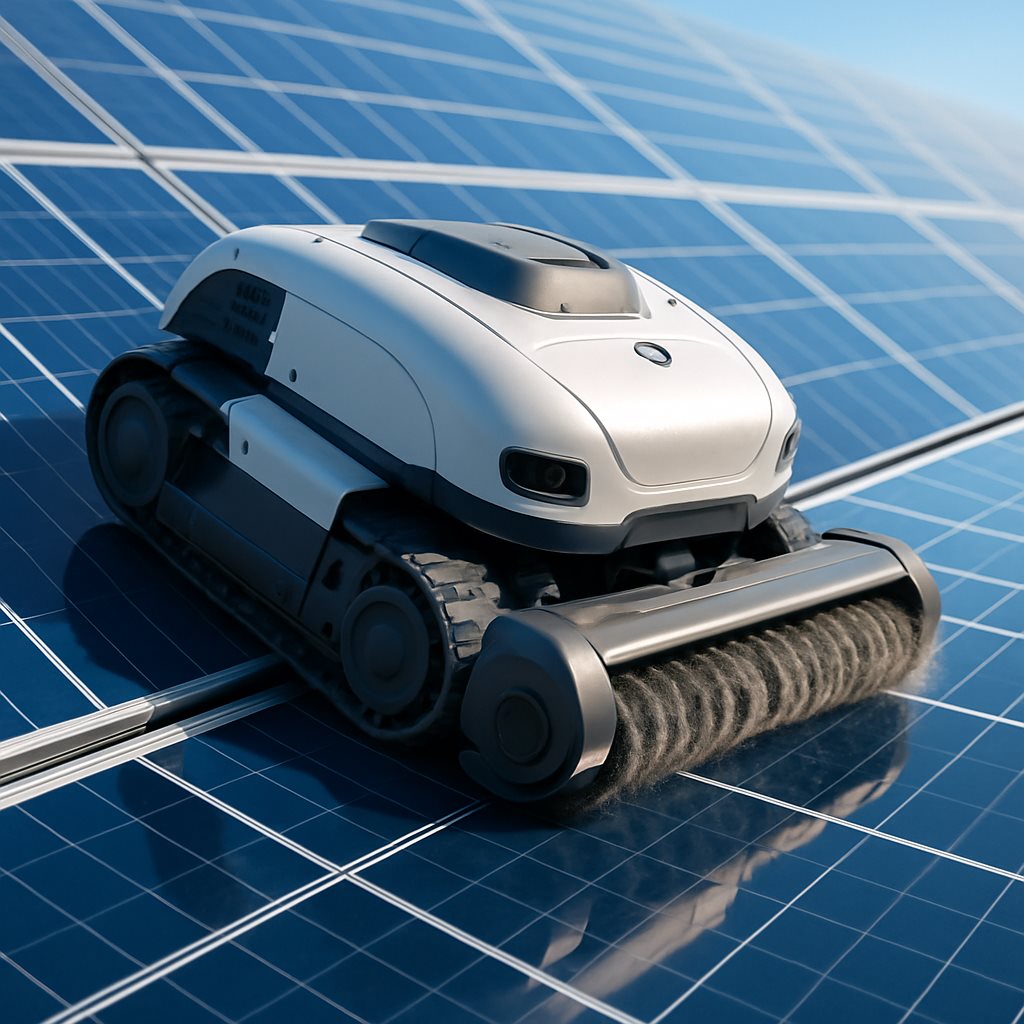
For utility-scale and commercial arrays – where the goal is consistent, thorough cleaning across a large surface at low cost – ground robots are usually the stronger choice. They clean harder soiling, run without a flight-time ceiling, and use water efficiently. Drones can complement them on unusual or scattered layouts, but as a primary cleaning method at scale, contact-based robotic cleaning is more reliable. Weigh either against your site using our guide to the ROI of autonomous cleaning, and see how to evaluate a system in our buyer’s guide.
The Bottom Line
Drones offer access and speed; ground robots offer cleaning power, endurance, and water efficiency. For keeping large PV sites consistently clean and productive, contact-based robotic cleaning is the more dependable workhorse. To see how a robotic system performs on your array, request a demo.
Frequently Asked Questions
Are drones or robots better for cleaning solar panels?
For thorough, consistent cleaning at scale, ground robots generally win because they clean in contact with the glass and have no flight-time limit. Drones can help on scattered or hard-to-access layouts.
Can cleaning drones remove stuck-on grime?
Not well. Spraying from the air rinses loose dust but struggles with bonded soiling like bird droppings and pollen, which need mechanical contact to remove safely.
Which uses less water, a drone or a robot?
Ground robots tend to use water more efficiently because they clean in contact with the panel, whereas aerial spraying loses water to overspray, drift, and evaporation.
Do cleaning drones need less infrastructure than robots?
Drones need no equipment on the array, but rail-free ground robots also avoid fixed infrastructure – and water-powered models need no grid electricity or batteries.
Can drones and robots be used together?
Yes. On some sites a robot handles the bulk of the array while drones cover scattered or awkward sections, but for primary cleaning at scale robots are usually the core method.