
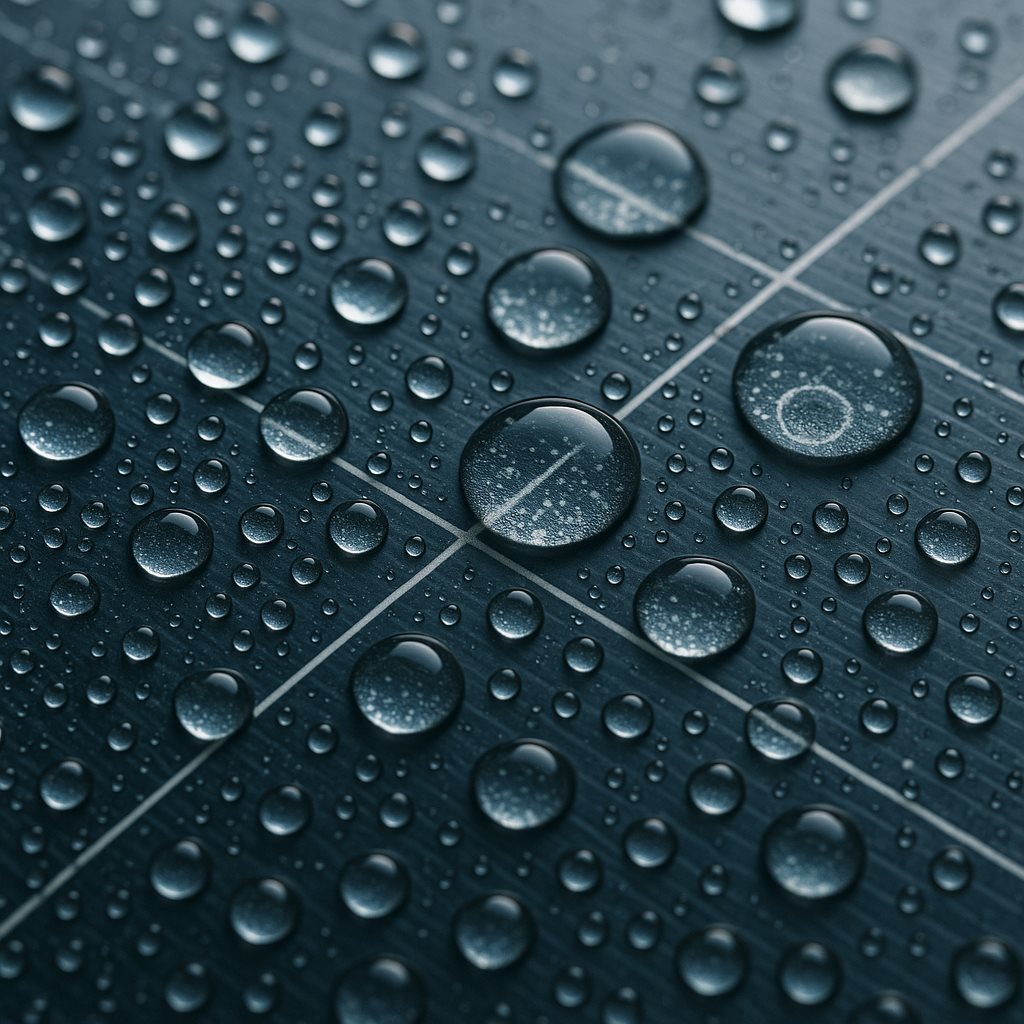
Two crews wash the same block of modules on the same morning with the same brushes. One block dries clear. The other dries covered in a fine white haze that no amount of rinsing removes, and by the following week it is holding dust like flypaper. Nothing about the technique differed. The only variable was what came out of the tap. Water quality for solar panel cleaning decides whether you have removed soiling or simply replaced it with a harder version of the same problem.
Why the water matters more than the brush
Cleaning a module is a two-stage event. The brush or the water jet lifts particles off the glass, and then the water evaporates. Whatever was dissolved in that water stays behind, bonded to the surface.
Tap water, well water and most site supply water carry dissolved calcium, magnesium, silica, sodium and chlorides. As a droplet dries on hot glass, those minerals concentrate at the droplet edge and crystallise. The result is the classic ring-shaped water spot. It is not cosmetic. Mineral film scatters incoming light, and because it is chemically bonded rather than loose, the next cleaning pass will not lift it.
Worse, the deposit is rough at a microscopic scale. Rough glass holds dust that smooth glass would shed, so soiling rates climb after every cleaning cycle with poor water. Sites in this condition often report that cleaning stopped helping, and conclude the problem is the cleaning method. It is the water.
The four numbers that define cleaning water
Ask your water supplier or run a field test for these four values before you design any cleaning program.
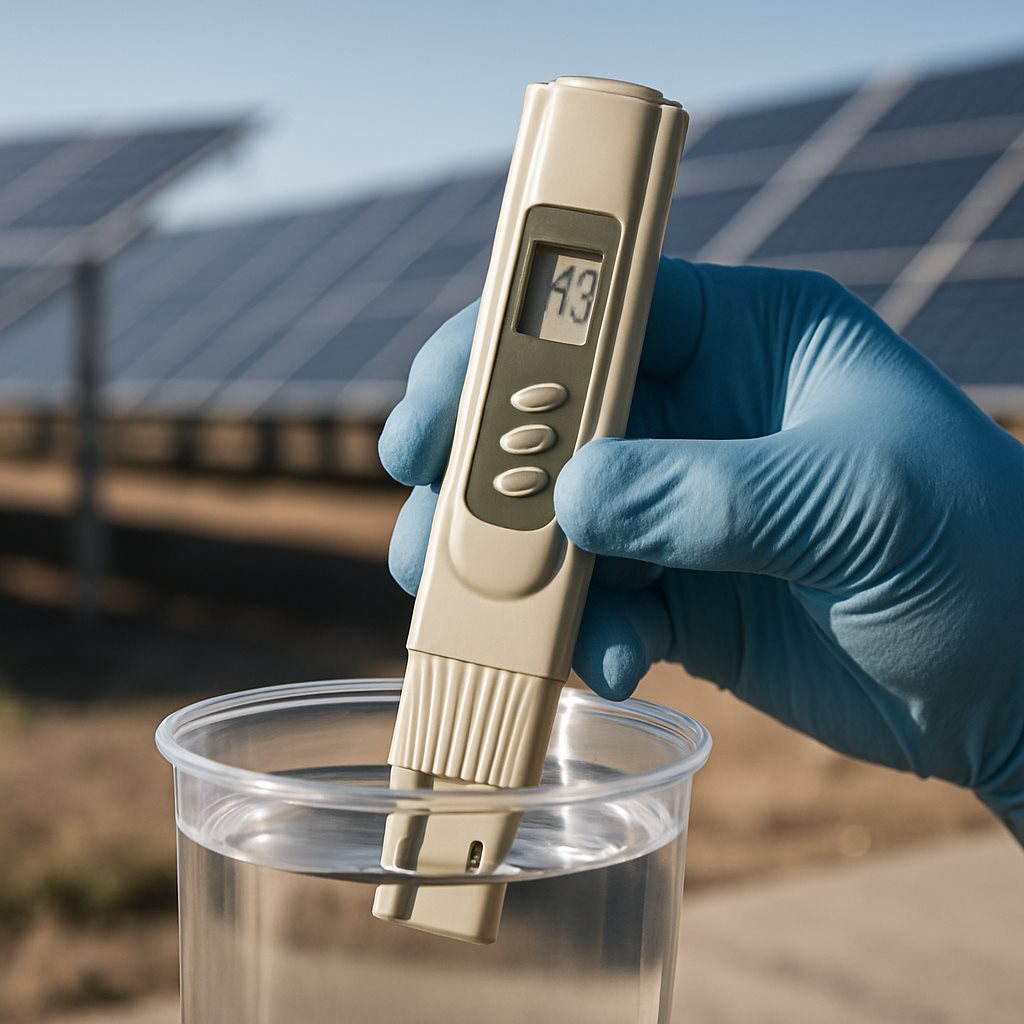
TDS (total dissolved solids), in ppm. The headline number, measured in seconds with a handheld meter. It tells you how much material a drying droplet will leave behind. Municipal supply typically runs somewhere between 150 and 500 ppm. Well water in arid regions is often far higher. Professional spot-free cleaning targets water in the low single digits, and purified water below roughly 10 ppm dries without visible residue on glass.
Hardness, as mg/L of calcium carbonate. Specifically the calcium and magnesium fraction. Hardness is what produces scale, the deposit that survives repeat cleaning and eventually requires acid treatment to remove. Acid treatment is precisely what module warranties exclude.
Silica, in ppm. The one people forget. Dissolved silica forms a deposit that behaves like a thin layer of glass fused onto glass. Standard water softening does not remove it, and once it has built up, mechanical removal risks the anti-reflective coating.
Chlorides, in ppm. Not a spotting issue but a corrosion issue. Chloride-rich water accelerates attack on the aluminium frame, mounting hardware and grounding connections. It matters most at coastal sites, where the ambient environment is already contributing salt.
pH is worth recording as a fifth data point, mostly as a warning flag. Water outside roughly 6 to 8 is aggressive toward sealants and anodised frames.
What hard water actually does over five years
The damage is cumulative and slow enough to be invisible in monthly reports.
Year one produces light spotting that a good rinse mostly handles. By year two the deposit has built into a persistent film that reduces transmission across the whole module face, so the loss is uniform and never appears as an obvious fault. By year three the roughened surface is accelerating re-soiling and cleaning intervals shorten. Somewhere around year four somebody proposes a chemical restoration, which either damages the coating or voids a warranty clause, and often both.
None of it shows up as a failure. It shows up as a performance ratio that has drifted three or four percent below the model, with no single component to blame. It is the same quiet financial pattern described in our look at the hidden costs of inadequate solar panel cleaning.
Treatment options and what they cost you
There is no single right answer, only a match between source water and site constraints.
- Sediment and carbon filtration. Cheap, essential, and removes only suspended particles. It does nothing to TDS. Treat it as the first stage, never the whole solution.
- Ion exchange softening. Swaps calcium and magnesium for sodium. It stops scale, but total dissolved solids stay high, so spotting continues. Useful upstream of other treatment, insufficient on its own.
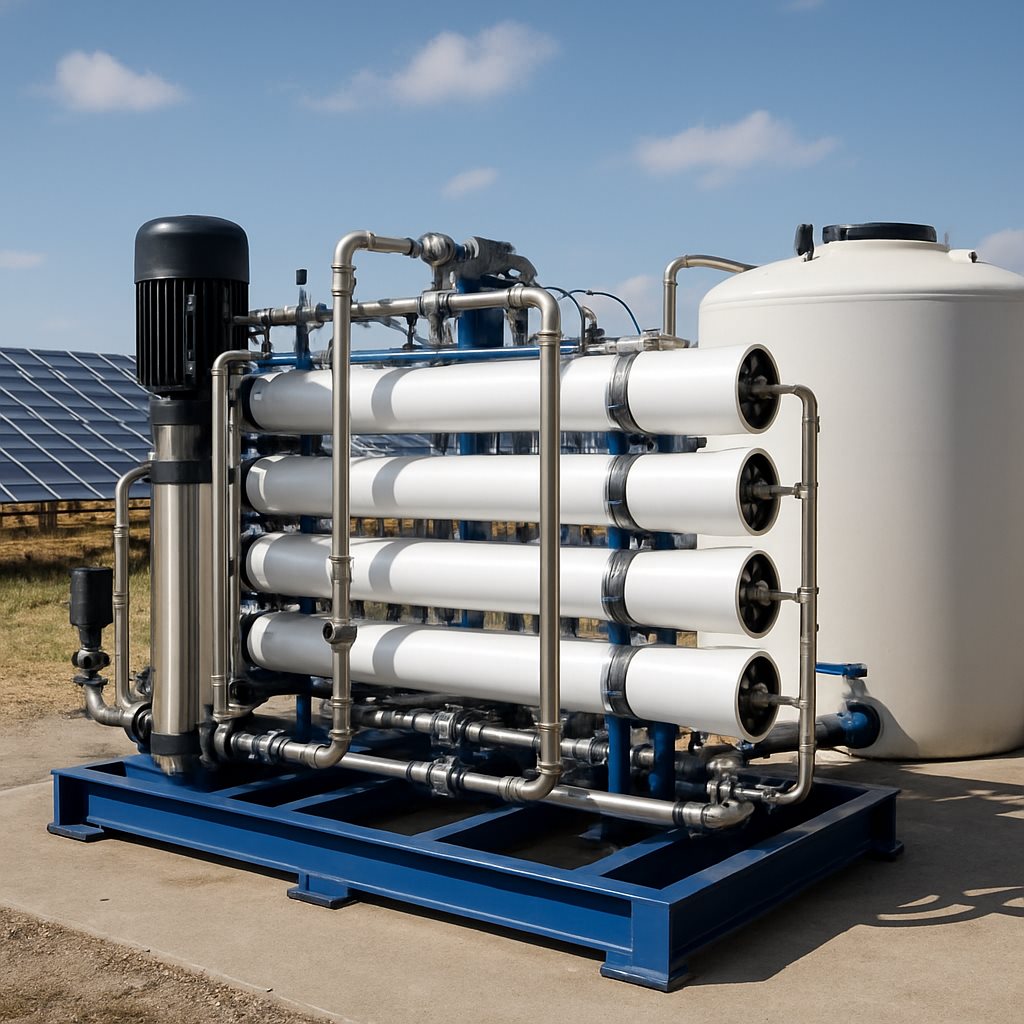
- Reverse osmosis. The workhorse for solar sites. Removes the large majority of dissolved solids including silica, and delivers water in the range where spotting stops. The trade-off is reject water, typically a meaningful fraction of throughput, which matters where water is scarce or discharge is regulated.
- Deionisation resin. Polishes water to near zero TDS. Excellent output quality, but resin consumption scales directly with input TDS, so running DI on untreated hard water is expensive. It belongs after reverse osmosis, not instead of it.
The practical configuration for most utility-scale sites is filtration followed by reverse osmosis, with a DI polishing stage only where the source is unusually difficult. Storage capacity then buffers the treatment rate against cleaning demand.
Brackish, recycled and coastal supply
Plenty of solar plants sit where good water does not exist. Desert sites often draw brackish groundwater at several thousand ppm. Agricultural sites may have access to treated effluent, which is low cost but carries organics and nutrients that leave a biological film on glass. Coastal sites face chloride loading from both the water and the air.
In each case the answer is the same in structure: treat to a defined specification, then design the cleaning system to use as little of that treated water as possible. Treatment cost scales with volume, so a system that cleans well on a few litres per module changes the economics of water treatment entirely. That is the connection between water chemistry and machine design, and it is why the two decisions should never be made separately. Our discussion of water management in arid-region solar farms covers the volume side of the same equation.
How robotic systems change the water requirement
Manual crews clean infrequently and therefore clean hard: heavy soiling needs volume, pressure and dwell time. Automated systems clean frequently and therefore clean light, and light cleaning tolerates a wider water specification because there is less deposit to dissolve and less standing water to evaporate on the glass.
Machine-applied water is also metered rather than sprayed. Volume per module is known, contact time is controlled, and the water is delivered where it does work instead of running down the frame. Solaris Hydrobotics systems apply water through the cleaning head at low pressure for exactly this reason, an approach explained further in the breakdown of how water-powered solar cleaning robots work.
The practical outcome is that treated water becomes affordable. Purifying a small, predictable daily volume is a manageable operating cost. Purifying the volume a quarterly manual campaign needs, in a two-day burst, usually is not.
Writing a water specification for your site
A workable specification has five lines. Source and its measured TDS, hardness, silica and chlorides. Target quality at the nozzle. Treatment train and its capacity. Storage volume and turnover. Testing interval, because source water changes seasonally and well water changes as the aquifer draws down.
Test quarterly at minimum, and always after a change in source. A site that switched from municipal supply to a new borehole and kept the same cleaning routine is the most common way a well-run program starts leaving deposits.
The bottom line
Cleaning equipment gets specified in detail while the water it uses is treated as a utility that either exists or does not. That gets the priority backwards. The wrong water will leave a permanent deposit on a 25-year asset, and it will do so while every cleaning report says the work was completed on schedule.
Measure the source, set a target, size the treatment to the volume your cleaning method actually needs, and retest as conditions change. If you are evaluating cleaning approaches, put the water specification on the same page as the machine specification and compare them together.
Frequently Asked Questions
What TDS level is safe for cleaning solar panels?
Water below roughly 10 ppm TDS dries on glass without visible residue, which is why professional spot-free cleaning targets that range. Between 10 and about 100 ppm you will see light spotting that worsens on hot glass. Above a few hundred ppm, deposits build up faster than routine cleaning removes them.
Can I clean solar panels with tap water?
Sometimes, depending on the supply. Soft municipal water at low TDS with a controlled drying process can be acceptable. Hard tap water leaves mineral film that reduces transmission and roughens the glass surface. Test before assuming, because a meter costs less than a single season of avoidable loss.
Is deionised water necessary for solar panel cleaning?
Not always. Reverse osmosis alone brings most source water into an acceptable range. Deionisation is worth adding where the source is unusually mineralised or where a completely spot-free finish is required, and it works most economically as a polishing stage downstream of reverse osmosis.
Does hard water damage solar panels permanently?
Mineral scale and silica deposits bond to the glass and resist normal cleaning. Removing them mechanically or chemically risks the anti-reflective coating, which is a permanent loss. Preventing the deposit is far cheaper than any method of removing it.
How much water does robotic cleaning use per panel?
Considerably less than manual washing, because water is metered through the cleaning head rather than sprayed across the array. Exact volume depends on soiling load and system design, but the reduction is large enough to make on-site water treatment economically viable at sites where manual cleaning volumes would not be.
How often should cleaning water be tested?
Quarterly as a baseline, and immediately after any change of source such as a new borehole, a switch to recycled supply or a seasonal change in the water table. TDS can be checked on site in seconds; hardness, silica and chlorides need a laboratory analysis, which is worth commissioning annually.