

Desert soiling is dust that sits on glass until something removes it. Coastal soiling is chemistry. Sea salt aerosol lands on the module, absorbs moisture from humid night air, dissolves into a film, then recrystallises as the sun comes up, and does it again the next night. After a few weeks of that cycle the deposit is no longer sitting on the glass. It is bonded to it. That is why coastal solar farm cleaning follows different rules from the desert playbook most O&M programs are built on.
Why salt behaves differently from dust
Sodium chloride is hygroscopic. Above roughly 75 percent relative humidity it deliquesces, meaning it pulls water out of the air and turns into solution. Coastal sites cross that threshold most nights.
The consequences follow directly:
- The deposit is mobile. Dissolved salt migrates across the glass and collects at module edges, frames and the lower rail where water runs, which is why coastal modules often show a heavy band at the bottom edge while the centre looks acceptable.
- It cements everything else. Salt solution acts as a binder for dust, pollen and organic matter. The mixed deposit that results is far harder to remove than either component alone.
- It re-forms without new deposition. Even on a still day with no wind off the sea, the existing salt on the panel goes through another dissolve-and-crystallise cycle. The deposit tightens over time on its own.
- Rain is unreliable as a cleaner. Light rain dissolves the salt and redistributes it rather than washing it off, and can leave the module worse than before it fell.
The distance from the shoreline matters more than most site assessments allow for. Aerosol deposition falls off sharply inland, so a plant 500 metres from the water and a plant 5 kilometres inland face genuinely different maintenance problems even though both sit in the same climate zone described in our overview of climate-specific solar panel cleaning.
The asset risk that yield reports do not show
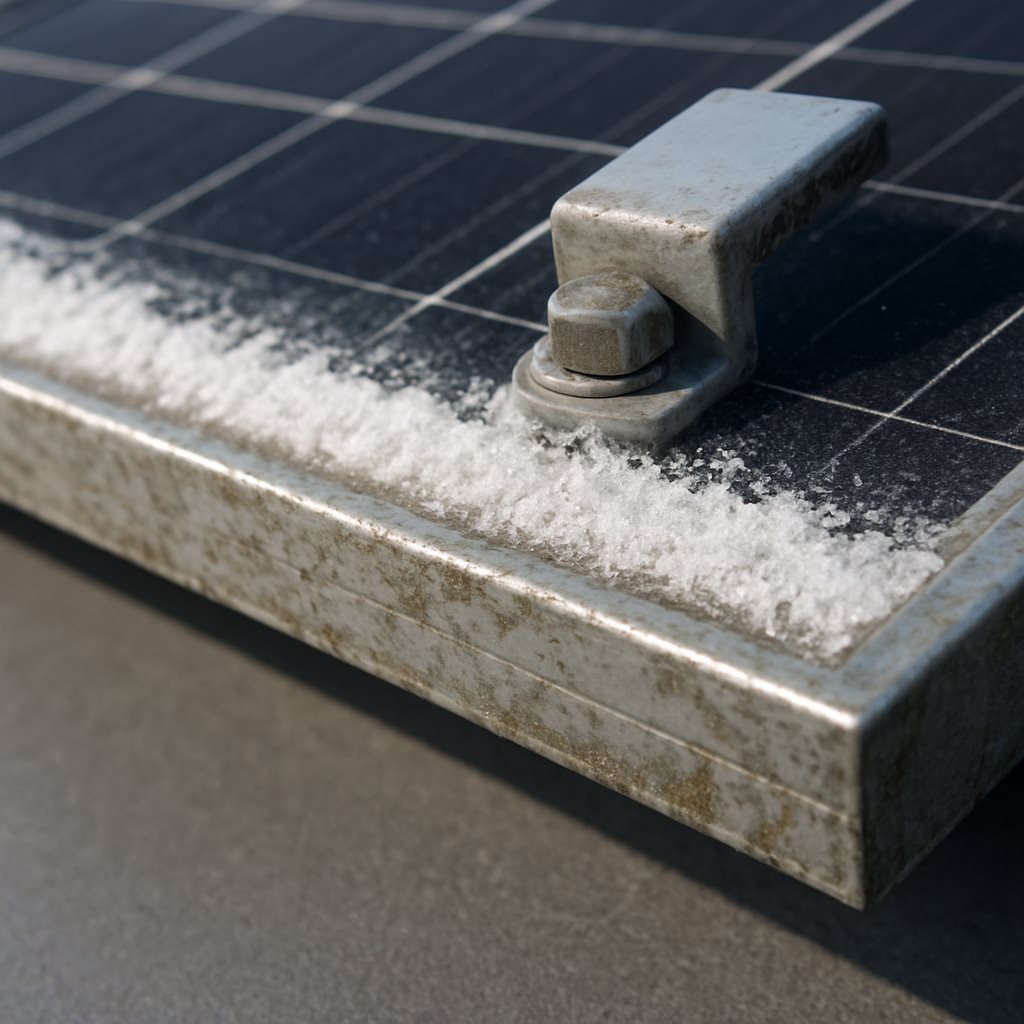
Lost production is the visible cost. Corrosion is the expensive one.
Chloride attacks the aluminium frame, the mounting hardware, earthing connections and, where the seal is compromised, the junction box and connectors. Module manufacturers recognise this: IEC 61701 defines a salt mist corrosion test specifically for modules intended for marine and coastal environments, with graded severity levels. Modules certified to it are built for the exposure. Balance-of-system hardware very often is not, because it was specified from a generic bill of materials.
Persistent salt film also holds moisture against the glass and the frame for longer each night, which extends the wetted time that drives corrosion. Cleaning a coastal array is therefore not only a yield measure. It is asset protection, and it protects components that are considerably harder to replace than a module.
Why quarterly manual cleaning fails at the coast
The standard O&M pattern is a small number of intensive cleaning campaigns per year. In a coastal environment that pattern loses on both ends.
Between campaigns, the deposit passes through dozens of dissolve-and-crystallise cycles and cements hard. When the crew finally arrives, light cleaning no longer works, so they escalate: more pressure, more dwell time, harder contact, sometimes a detergent. Every one of those escalations moves toward the exclusions written into the module warranty, and the abrasion risk is the same mechanism described in our analysis of cleaning methods that damage panels over the long run.
Then the cycle restarts, and within weeks the array is halfway back to where it was. The economics are poor in both directions: high production loss for most of the year, and high intervention cost when the work finally happens.
Method: what actually removes salt

Salt is water soluble, and that single fact should drive the whole method decision.
Dry brushing does not work. It cannot remove a dissolved and recrystallised film, and dragging a brush across a hardened salt-dust crust is abrasive to the anti-reflective coating. Waterless approaches that perform acceptably in dry desert conditions are the wrong tool here, a distinction worth understanding alongside our comparison of wet and dry solar panel cleaning technologies.
Rinse volume matters more than pressure. Removing salt is a dilution problem, not a scrubbing problem. Enough clean water with enough contact time dissolves the deposit and carries it off the module. High pressure adds risk at the frame seal without adding dissolving power.
Water quality is not optional. Rinsing salt off with brackish or chloride-rich water leaves chloride behind, which is the failure mode most often found where sites use untreated coastal groundwater. The supply needs testing for chlorides specifically, not just for hardness.
Do not forget the drainage path. The runoff carries concentrated salt solution across the lower module edge, the frame and the mounting rail. A method that floods the array and leaves it to drip is depositing salt exactly where corrosion starts.
Frequency: short intervals beat deep cleans
The controlling variable at a coastal site is not how much salt has accumulated. It is how long any given deposit has been allowed to cycle.
Frequent light cleaning interrupts the cementing process. The deposit never reaches the state that requires aggressive removal, so cleaning stays gentle, water use per pass stays low, and the array spends most of its time near its clean baseline instead of oscillating between clean and heavily soiled.
That is a schedule almost no manual contractor can deliver economically, because the cost per campaign is dominated by mobilisation rather than by the work itself. It is a schedule automated systems deliver by default, since the marginal cost of an additional pass is water and a small amount of energy. The general logic behind interval selection is set out in our solar cleaning frequency guide; coastal sites simply sit at the short end of the range.
Seasonality still applies. Onshore wind patterns, storm season and humidity all shift deposition rates through the year, so the interval should follow measured conditions rather than a fixed calendar.
What to monitor at a coastal site
Four measurements tell you whether the program is working.
Soiling ratio against a clean reference. The standard measure, and the only one that converts directly into lost revenue.
Recovery after cleaning. If output after a clean is not returning to the previous clean baseline, a residue is accumulating that the current method is not removing. This is the early warning that matters most, and it is usually visible in the data long before it is visible on the glass.
Edge and frame condition. Photograph the lower module edge, frame corners and earthing points at fixed intervals. Corrosion is progressive and easy to miss on walk-throughs.
Chloride in the cleaning supply. Test seasonally, particularly where the source is a borehole near the coast, since saline intrusion changes water chemistry over time.
The bottom line
A coastal plant is not a desert plant with more humidity. The soiling dissolves and re-forms, it binds other contaminants into a hard film, and it attacks the hardware while it does so. Programs designed around infrequent, intensive campaigns produce exactly the wrong result: a deposit that hardens between visits and an intervention aggressive enough to threaten the warranty.
The alternative is short intervals, generous rinse with genuinely clean water, and controlled contact. Solaris Hydrobotics builds water-based systems for precisely these conditions, including sites on the Israeli coastal plain where humidity and salt load are constant year round.
If you operate an asset within a few kilometres of the shoreline and your cleaning schedule is quarterly, the recovery-after-cleaning figure is worth pulling before anything else. It usually tells the whole story.
Frequently Asked Questions
How often should coastal solar panels be cleaned?
Considerably more often than inland sites, because salt deposits harden through nightly dissolve-and-crystallise cycles rather than simply accumulating. Short, frequent intervals that prevent cementing outperform occasional deep cleans, both in recovered yield and in reduced risk to the modules.
Does rain clean salt off solar panels?
Not reliably. Heavy rain can rinse a module effectively, but light rain dissolves the salt film and redistributes it across the glass and into the frame area, sometimes leaving the panel performing worse than before. Rain should never be treated as a substitute for a cleaning schedule at a coastal site.
Does salt damage solar panels?
Salt attacks aluminium frames, mounting hardware, earthing connections and connectors. IEC 61701 exists specifically to test module resistance to salt mist for marine and coastal deployment. Modules certified to it handle the exposure; generic balance-of-system components frequently do not.
Can dry cleaning methods remove salt deposits?
No. Salt requires water to dissolve, and brushing a hardened salt and dust crust dry is abrasive to the anti-reflective coating. Waterless systems suited to dry desert dust are the wrong choice for a coastal environment.
How far inland does salt soiling matter?
Deposition falls off sharply with distance from the shoreline, so exposure at a few hundred metres is very different from exposure at several kilometres. The practical test is measurement on site rather than a rule of thumb, since local wind patterns and topography strongly influence how far aerosol travels.
Can I use local groundwater to clean a coastal solar plant?
Only after testing it for chlorides. Coastal boreholes are subject to saline intrusion, and rinsing salt off a module with chloride-rich water leaves chloride behind. That is one of the most common reasons a coastal cleaning program stops recovering output despite being carried out on schedule.